A route for the actual loss
Separate a deleted file, a misplaced copy, a cloud placeholder and overwritten document content.
Protect the source. Find the right route. Verify the result.
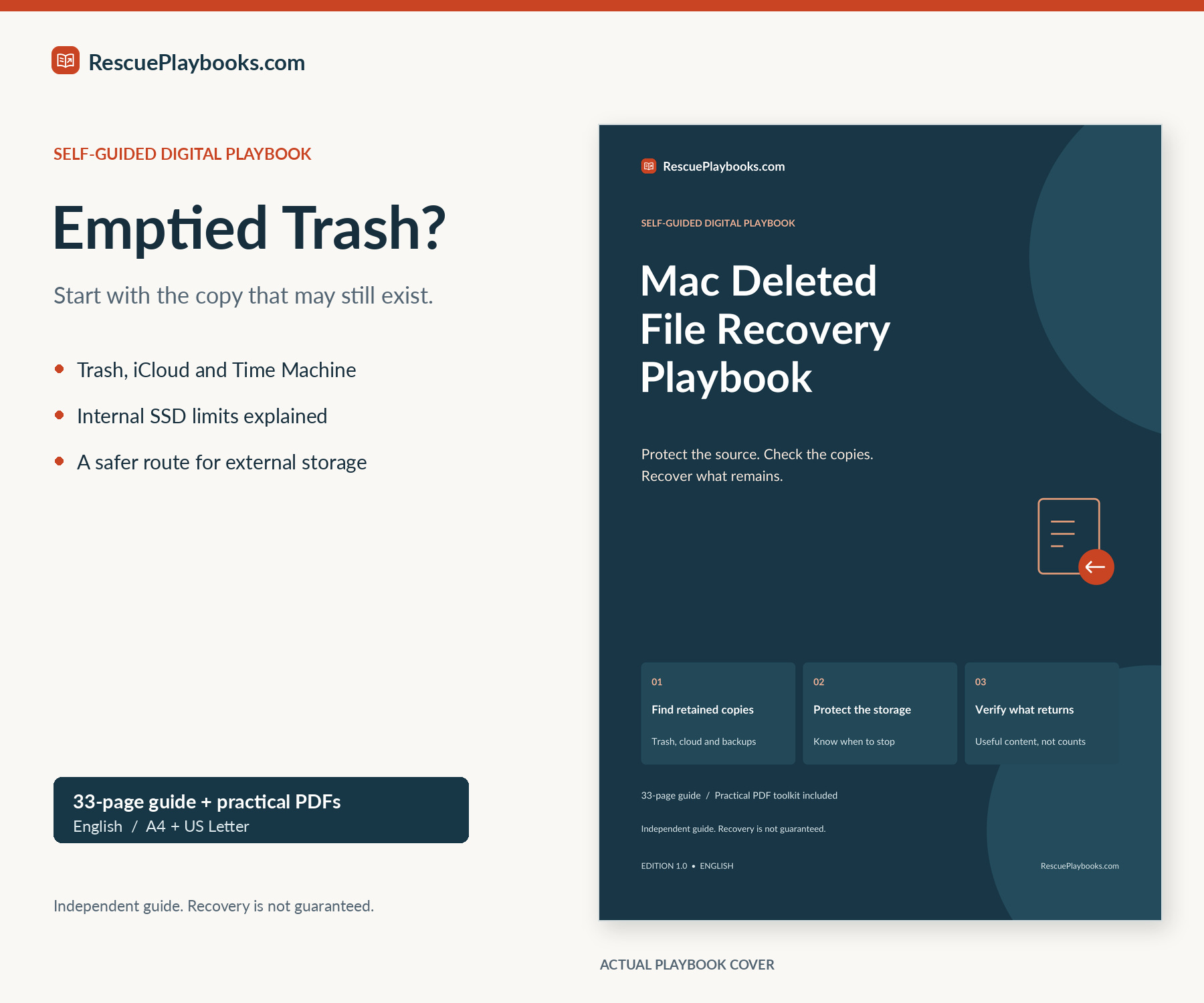

Follow a source-first workflow for Trash, iCloud Drive, Time Machine, local snapshots and supported app recovery areas. When no retained copy is available, distinguish internal-SSD limits from a controlled healthy-external-drive image workflow. Verify actual content, record partial results and know when to stop.
Not a data recovery service. We do not access your Mac, inspect your files or carry out recovery steps for you.
Recovery is not guaranteed. Results depend on surviving data, backups, retention, permissions, encryption and storage condition.
Independent publication. Not affiliated with or endorsed by Apple, Microsoft, R-Tools Technology or CGSecurity. You are paying for an independently organized guide, practical PDF worksheets and adaptable messages—not recovery software, access to Apple support or work performed on your device.
Focused guidance. Practical resources. Clear next steps.
Separate a deleted file, a misplaced copy, a cloud placeholder and overwritten document content.
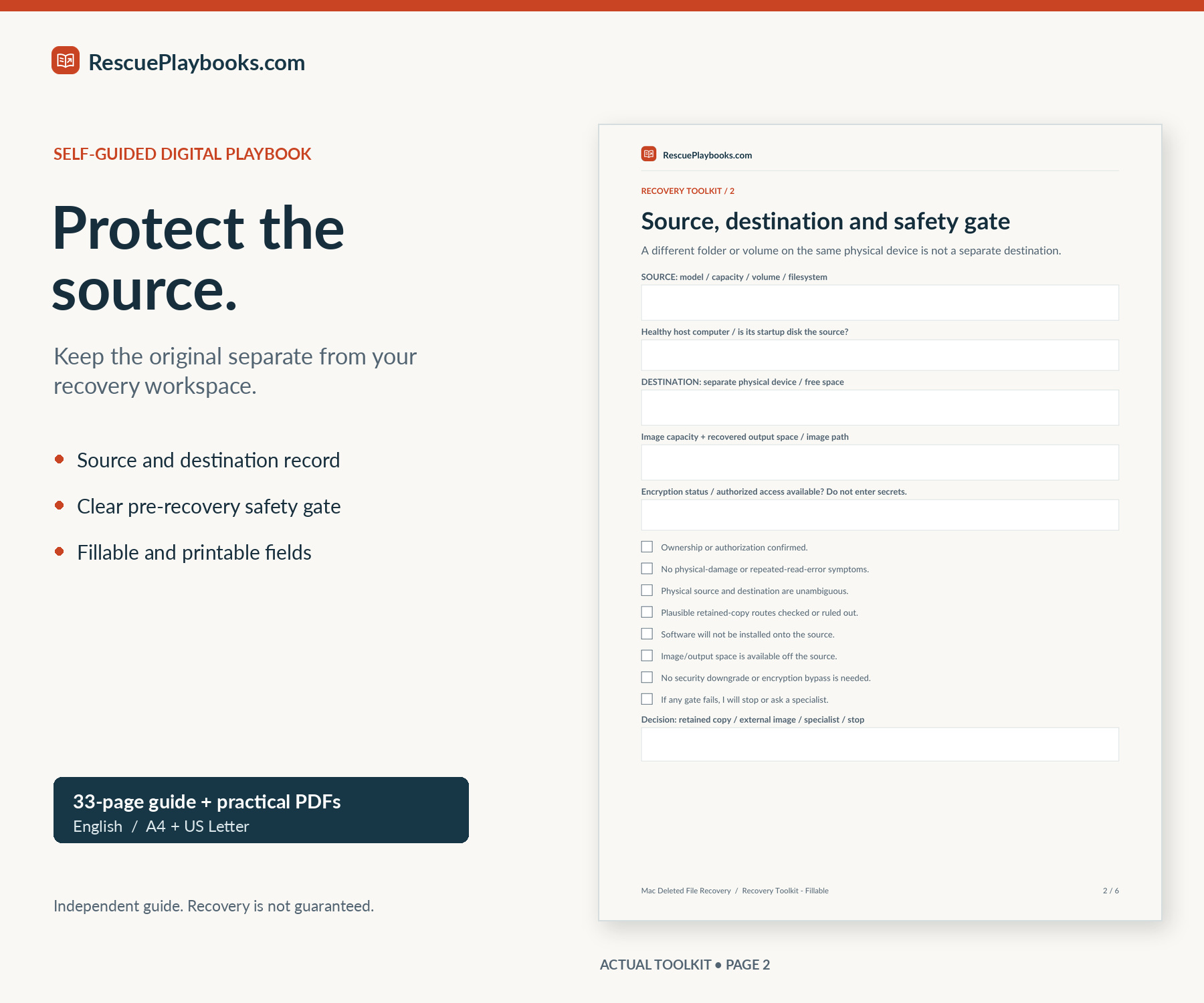
Identify the physical source and destination, avoid destructive shortcuts and recognize stop conditions.
Check retained items, Time Machine, local snapshots and copies held by an owner or administrator.
Use supported document versions and Photos Recently Deleted without treating them as a universal undelete tool.
Follow a documented R-Studio example for imaging, inspection, scanning and export, plus an optional PhotoRec image-only route.
Understand SSD/TRIM and FileVault boundaries; judge actual saved content rather than filenames or scan counts.
Record the incident, storage gate, attempts, candidates, verification and final next action.
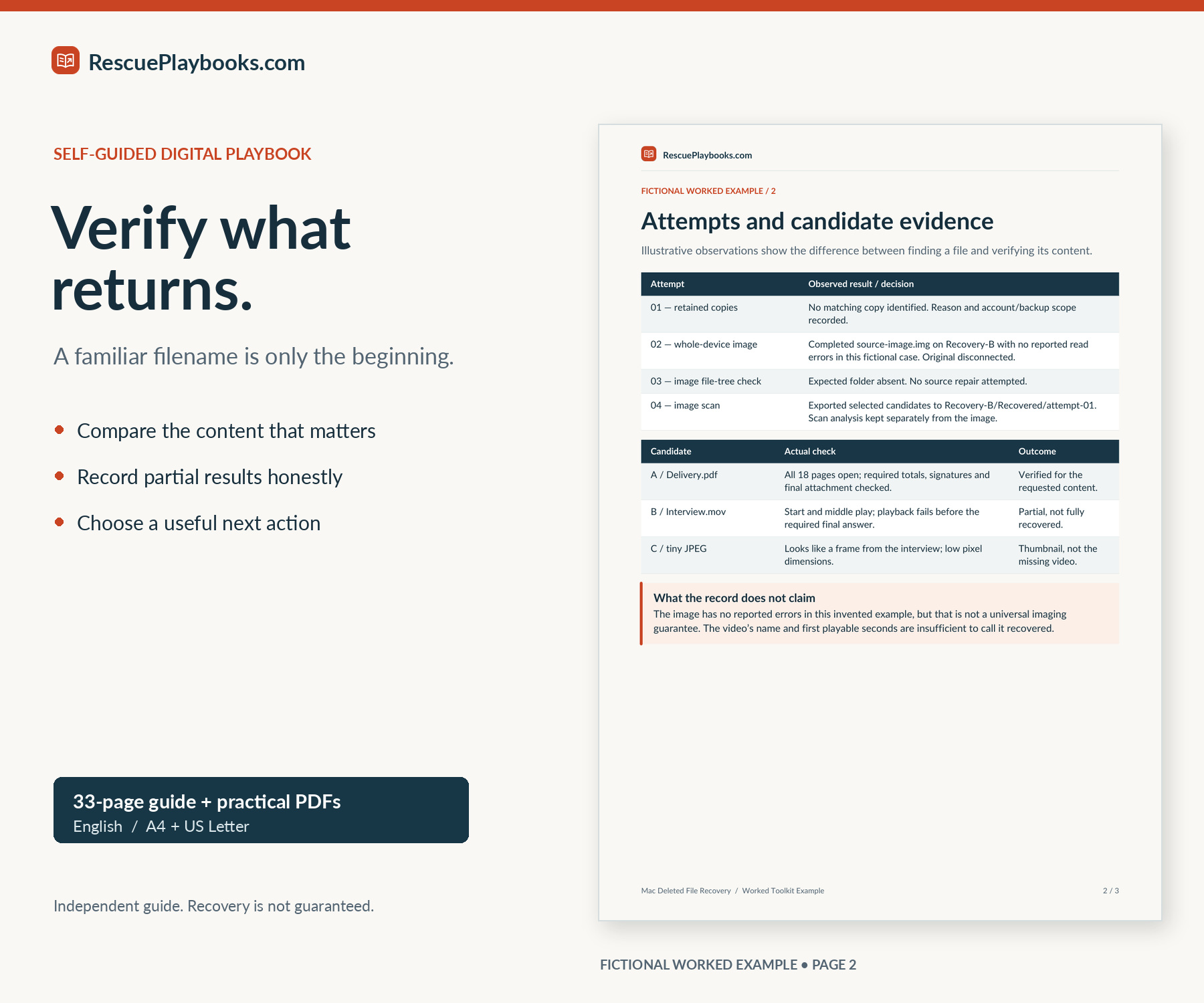
Use fictional worked records and focused requests for a collaborator, administrator, specialist or software vendor.
Choose your paper size. Keep the practical tools beside you.
Source-first recovery routes, fictional scenarios and 24 linked official/vendor references.
Read on screen or print the size that matches your paper.
Quick Start, fillable toolkit, worked example, and adaptable messages.
A4 and US Letter editions contain the same content. No audio file is included.
Hands-on recovery, remote computer access, one-to-one technical support, recovery software licenses or storage hardware. Physical drive repair, low-level internal Mac acquisition, RAID or Fusion Drive reconstruction, enterprise retention administration or Photos library-database repair. Password or encryption bypass, recovery of content that was never retained anywhere, reversal of processed TRIM, or any guaranteed recovery outcome.
Independent publication. Not affiliated with or endorsed by Apple, Microsoft, R-Tools Technology or CGSecurity. Recovery software licenses and specialist services are not included.
Check retained copies before deciding whether a storage-recovery attempt is appropriate.
Distinguish deletion from account, folder and sync changes, then use the relevant cloud route.
Check whether an existing backup or local snapshot can supply the needed file without clearing retained history.
Use the source/destination gate before imaging and analyzing a copy on a healthy Mac.
Compare saved candidates, check required content and record partial results honestly.
Recognize internal-SSD, encryption and physical-failure limits, then prepare a focused handoff.