A route for the actual incident
Choose between a suspected SIM/eSIM change, a pending or completed port, lost verification access and other causes of lost service.
Protect the number. Contain the damage. Verify the recovery.
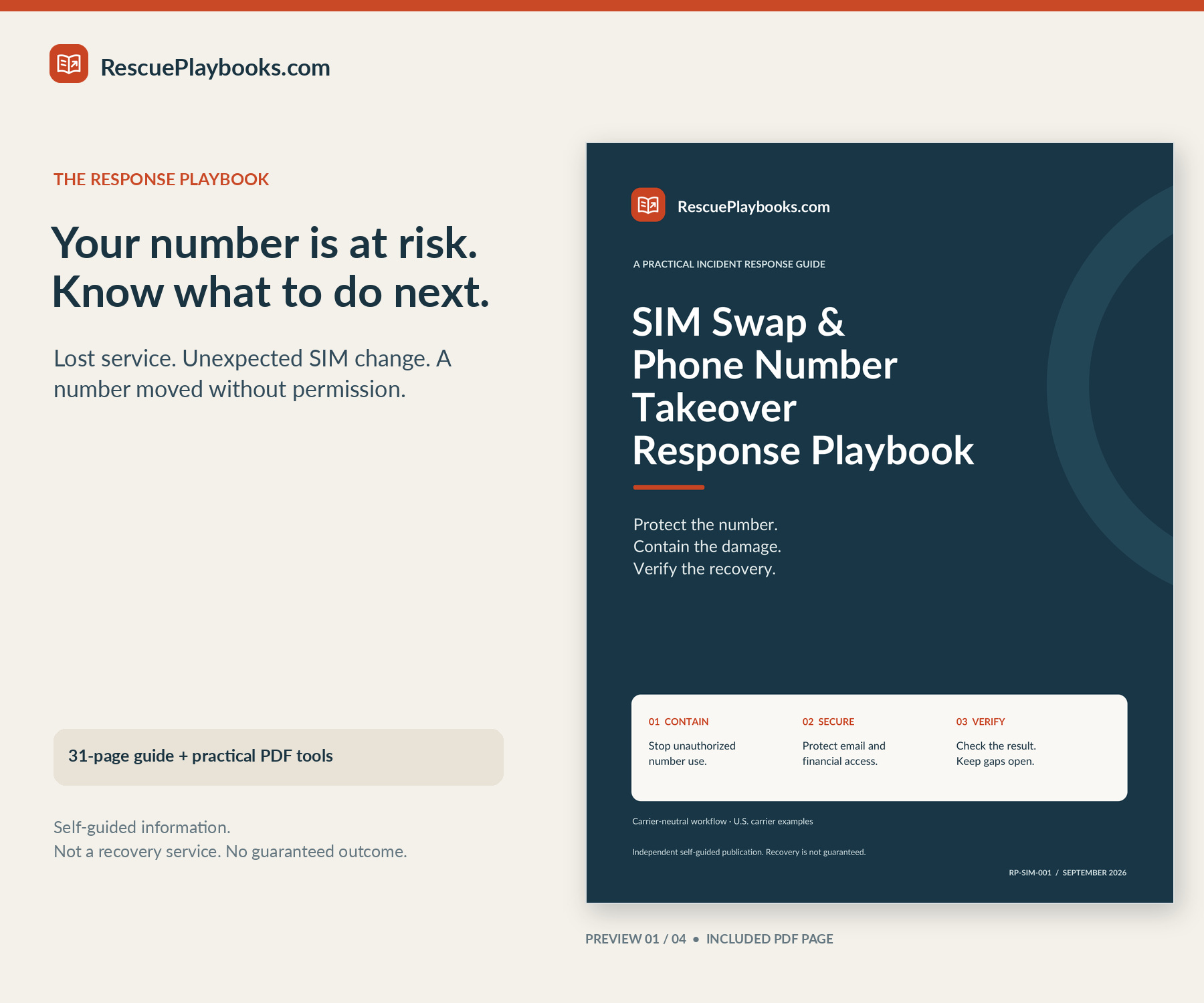
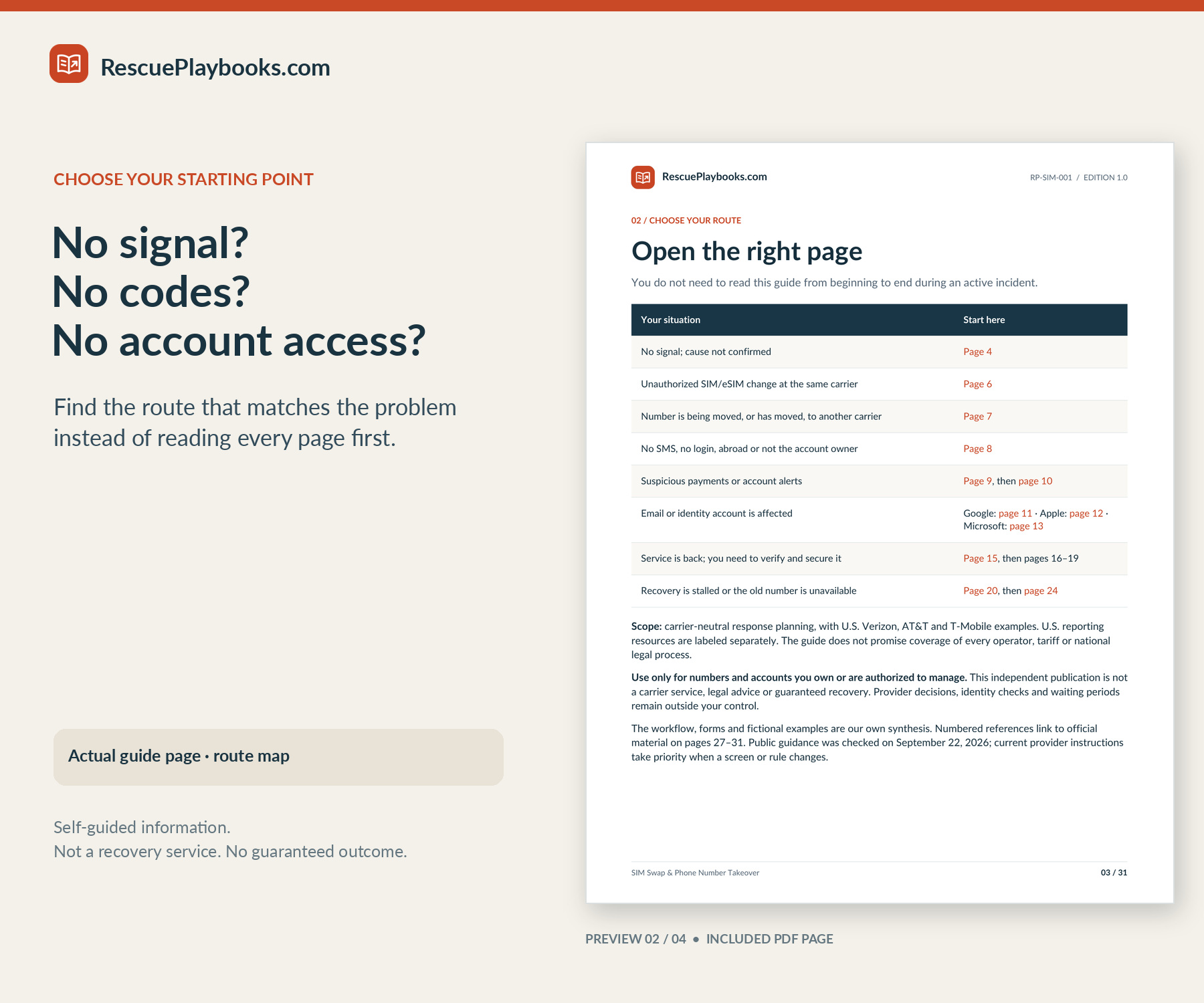
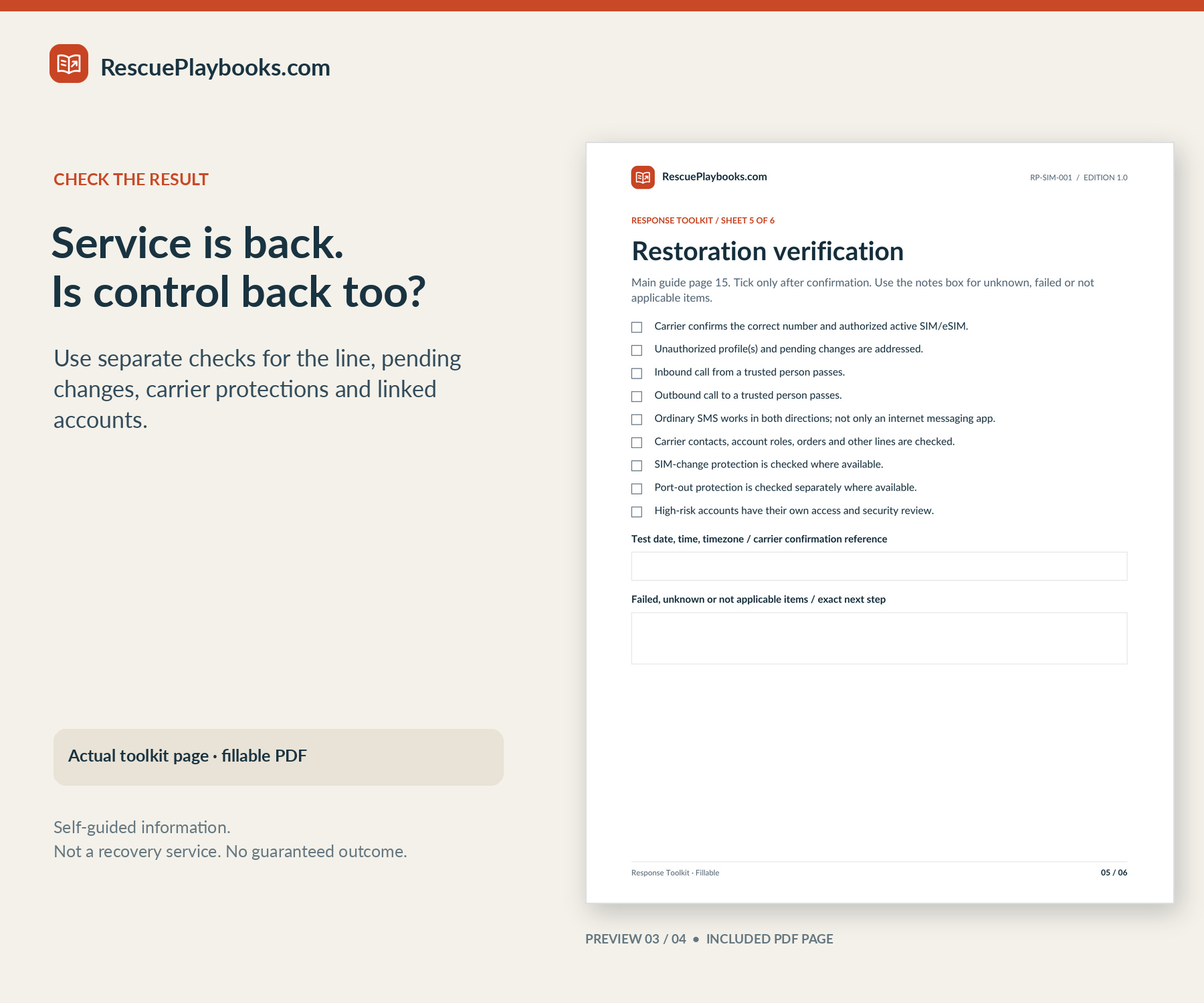
Follow separate routes for an unauthorized SIM/eSIM change or number transfer. Coordinate the carrier case, contain financial exposure, secure linked accounts, and check the result without relying on a returned signal alone. Includes a carrier-neutral workflow with detailed U.S. carrier examples.
Not a recovery service. We do not access your accounts, contact your carrier, reverse transfers, or recover funds for you.
Number restoration, account access, reimbursement, timing and provider decisions are not guaranteed.
Independent guide. Not affiliated with or endorsed by any carrier, platform, bank or government agency. You are paying for an independently organized response workflow, PDF worksheets, fictional examples and adaptable messages—not carrier support access, recovery software or work performed on your behalf.
Focused guidance. Practical resources. Clear next steps.
Choose between a suspected SIM/eSIM change, a pending or completed port, lost verification access and other causes of lost service.
Coordinate carrier containment, the email or password manager behind other accounts, and financial-provider contact.
Separate Verizon, AT&T and T-Mobile guidance, with plan, account-role and verification limitations called out.
Use Google, Apple and Microsoft response starting points and an inventory for other accounts tied to the number.
Check the authorized line, calls, ordinary SMS, pending changes, account roles and separate SIM/port protections.
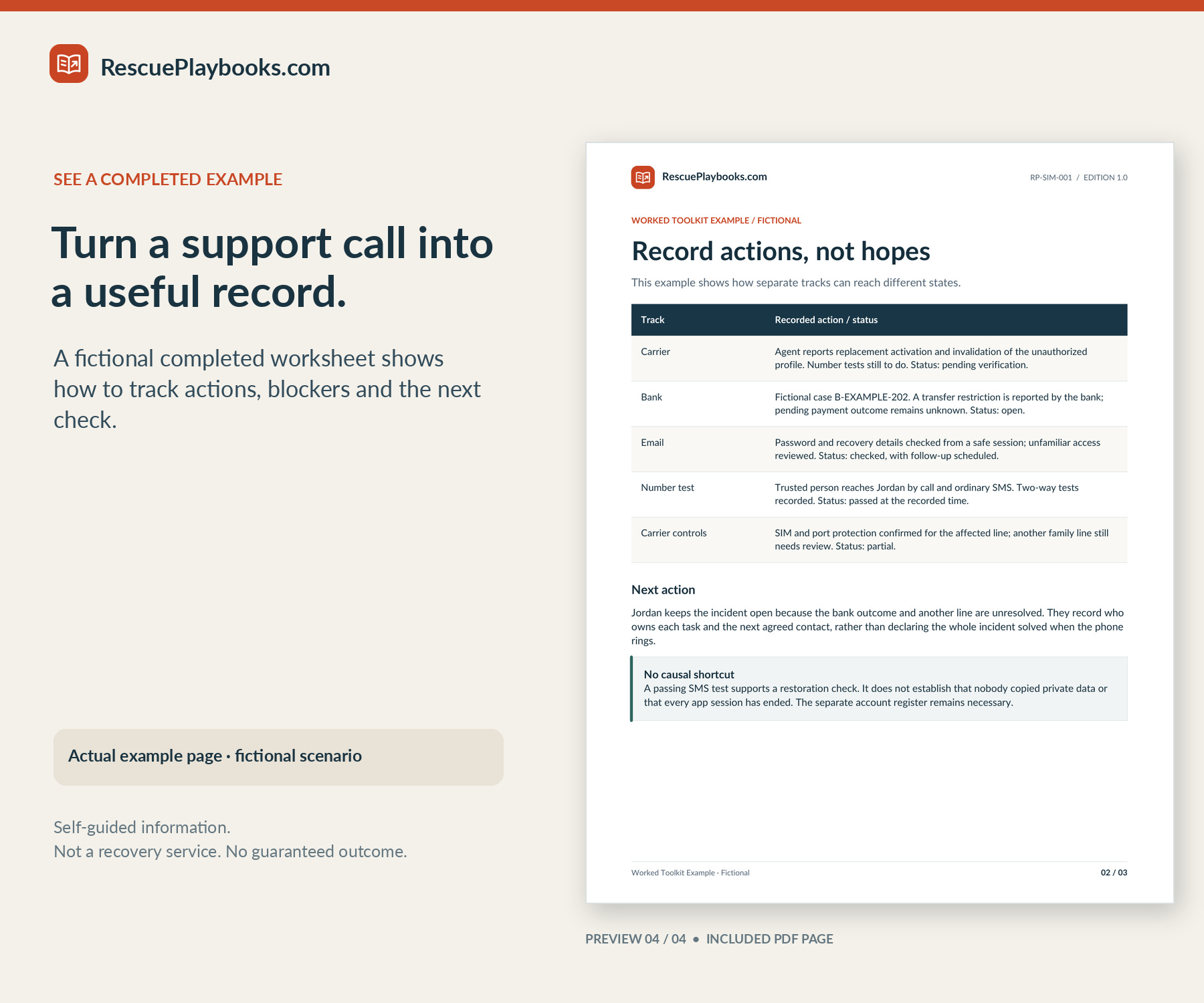
Record the incident, carrier case, linked accounts, financial response, restoration checks and unresolved actions.
See how to document a SIM incident and a stalled transfer without inventing a successful outcome.
Prepare focused carrier, financial-provider, account-support and follow-up requests without sharing incident secrets.
Choose your paper size. Keep the practical tools beside you.
The response workflow, detailed U.S. carrier examples and official source directory.
Read on screen or print the size that matches your paper.
Quick Start, fillable toolkit, worked example, and adaptable messages.
A4 and US Letter editions contain the same content. No audio file is included.
Hands-on recovery, carrier representation, remote access, one-to-one incident response, legal advice or a financial dispute service. Software, a replacement SIM/eSIM, security keys, provider fees, priority support, or paid access to any official recovery channel. Bypassing identity checks, controlling someone else’s number, reversing a legitimate reassignment, or guaranteeing restored access or reimbursement. An exhaustive manual for every carrier, country, bank or linked app. The detailed carrier examples and reporting section are U.S.-focused; Google, Apple and Microsoft sections are linked-account response starting points.
Independent guide. Not affiliated with or endorsed by any carrier, platform, bank or government agency. U.S. carrier examples and reporting resources are identified in the guide.
Separate an outage from a possible unauthorized SIM/eSIM change and prepare a focused carrier fraud report.
Use the pending or completed port-out route and track who is responsible for stopping or reversing the transfer.
Find the alternate verification route to ask for, including limits for prepaid, shared accounts and travel.
Run account and financial containment alongside the carrier case rather than waiting for the number to return.
Check ordinary calls and SMS, unauthorized changes, separate carrier protections and high-risk linked accounts.
Record the blocker, escalate through the right official route and work through a controlled new-number transition when necessary.